


aurik
-
Posts
713 -
Joined
-
Last visited
Everything posted by aurik
-
I tend to do my kata in one of 4 different ways: - Slow motion, focusing on making sure each move is *just right*. Trying to program new movement patterns into your brain. - Normal/full speed, no power - Again, going through the motions, getting the flow down - Slow speed, full power - Feeling how full power feels with each movement. Hit every movement with full power, then move on to the next one. - Balanced power & speed - the way you would perform the kata on a test or in a tournament. Find the balance of speed/power/expression that works for you. I find the slow motion kata to be an invaluable tool for letting your brain work through all the nuances of how a kata is supposed to look and give you a chance to get the muscle memory programmed just right.
-
Meijin gis are very popular at our dojo. They're available in 10oz (medium weight) or 14oz (heavyweight) cotton. They are extremely durable (we have students who have worn the same gi for 5+ years and it still looks pretty good), embroidery is available and a certain amount of embroidery is included. The prices are also very reasonable for a premium gi.
-
I think for me it would be Kanei Uechi. Kanbun Uechi was the founder of our style, but Kanei (his oldest son) evolved our style into what we know it as today. When Kanbun brought his karate over from China, he only had 3 kata, along with the kotekitae (conditioning exercises). When Kanei took over, he had senior instructors create 5 new "bridging" kata to ease the transitions from Sanchin -> Seisan -> Sanseiryu. Furthermore, after the bridging kata were developed, he modified them to create a clear progression between the 3 original kata through the 5 bridging kata. He also added the yakusoku kumite drills, the junbi undo warmups, and hojo undo supplementary exercises to the style. While other of Kanbun Uechi's senior instructors may have originally developed the additional kata and exercises, Kanei Uechi codified the curriculum and made the style what it is today.
-
Do any of you deal with performance or testing anxiety? I've seen quite a few young candidates for black belt ranks come through the dojo over the past few years (especially after I first earned mine back in 2022). One thing I frequently see in them is a high degree of performance/test anxiety. For the longest time, I struggled with performance anxiety myself; I would be terrified to get up and speak in front of an audience. In 2014, one of my professors asked me to study for a PhD under him, and I realized that at the end of the program, I would need to give a 1-hour presentation of my research in front of an audience, and handle any questions my advisory committee came up with. That scared the living heck out of me. So I went ahead and joined the University's Toastmasters club. Toastmasters is a great program if you're interested in learning to speak effectively, or to lead people or projects. If you're thinking about joining, I highly recommend it. However, I can distill some of my key lessons in a few bullet points: In most cases, the members of your test board want you to pass. This is doubly so if they are your instructors and have been teaching you for years. The test is a chance for you to show off everything you've learned over the past X years, and show your friends and family what you've learned. They aren't the enemy. If you make a mistake, keep going. The examiners may or may not notice. The absolute worst thing you can do is show your discouragement on your face. The thing I tell students is "whatever you don't do this: <puts my face in my hands, looks down and gives a huge, audible sigh>". If the test board wants you to repeat something, make them figure out that you made a mistake and ask you to repeat it. Take the opportunity to go through things in your head right before you perform. In our dan-grade exams, we perform either alone or in pairs, so there is a fair bit of downtime. Use some of that downtime to encourage your fellow candidates, but also use that time to visualize your performance and calm and center yourself. Do your best and try to have fun. A belt test is a big day for you. Show the testing board and audience your best work. There will be nerves. There will be adrenaline. Things will go wrong. The testing board knows this and will take this into account. Keep in mind that your instructor would most likely not be letting you test if he didn't think you were going to pass. So keep that silent vote of confidence in the back of your head as you get up there. I've been through 3 black belt testing cycles. Each of them have had different challenges. My shodan (1st degree) test: I wasn't sure what to expect. Our CI does make us watch the previous testing cycle so we know what to expect - sort of. However, that doesn't quite prepare you. One thing that went wrong on my test is that my CI (aka testing partner) smacked me fairly hard with a tettsui-uchi (hammer-fist strike) to the temple during our bunkai. I shrugged it off as best I could and was able to continue. On my nidan (2nd degree) test: during my sanchin shime (focus) testing, my examiner at one point attempted a roundhouse kick to my abdominals. He was a bit lower, and tapped me in the family jewels. It wasn't HARD, per se. But it definitely got my attention. On my sandan (3rd degree) test: I made a couple of mistakes and lost focus at a couple points in the test. In my sanchin test, I somehow ended up with the wrong foot forward. In my yakusoku kumite (prearranged sparring) drill, I somehow lost track of where we were in the drill and whispered to my partner "where are we"? In any case, I was able to make it through the process. In the end, I passed each test, despite the challenges each time around. The important thing is not to *look* flustered.
-
I've got a good, fast front kick that is a great deterrent to people coming in on me. Don't underestimate the front kick.
-
Shuri-Ryu combines their 3 naihanchi kata and calls it o-naihanchi
-
Honestly if you've got a lathe, making Tonfa shouldn't be that hard to do. It might take you a few tries to get it right, but if you practice on something fairly inexpensive like oak, it wouldn't be too difficult. The important thing is to get your dimensions right AND to make each piece identical. Sourcing the gigdee or ironbark will be extremely difficult however. I've looked at several sites I use to source my hardwoods and they don't even carry either of those. Have you considered something like desert ironwood? It's hard, dense, and fairly easy to source. Just make sure you wear a respirator when you work with it.
-
As I'm most familiar with Uechi-Ryu I'll contrast that with many of the other karate styles. One major difference in Uechi-Ryu isn't just that we kick with the toes, it is also how the kick is executed. We don't do a snap kick per se. We aim to chamber the kick with the foot parallel to the floor, and then the foot penetrates straight forward into the opponent, aiming for vital targets such as the bladder or floating ribs. In fact, one of the pieces of feedback I often hear on black belt tests is "kick forward not up". The second major difference, which our kobudo students need to often unlearn, is the way we use hip drive. In shotokan or many other styles, when you perform a punch or other strike, you'll see your belt flying all over the place while your hips add significant power to your strike. In Uechi-Ryu, the hip drive is still there, but much more subtle. The hips only move a few inches and the belt just wobbles a little bit.
-
I train at a fairly traditional Uechi-Ryu dojo. We use traditional training methods - body conditioning, kata which focus on open-hand techniques, our drills have many open-hand and definitely-not-legal-in-sport-karate techniques. Sparring in our dojo is usually more of a free-form sequence where most techniques are permitted as long as you take care to not injure your partner. Grabs are allowed. Leg kicks are allowed (and encouraged). Takedowns are allowed, provided you understand that the safety of your partner is your responsibility. When we spar the goal isn't to win or lose, it's not to get points. It is to demonstrate competence and confidence, and to show that you can put together combinations, and learn to read your opponents attacks and defenses. However, our CI and a number of our students do compete in tournaments, both locally and nationally. If students decide they want to compete, he will work with them on how to modify their kata and sparring techniques to be effective in the sport karate circuit. Under his guidance, several of our students have been successful both locally and nationally in various competitions. The way he puts it is if you teach the whole curriculum of our style and a student learns the "correct" way to do kata and spar, then it doesn't take many changes to adapt the sparring techniques and kata for competition. So I would argue that traditional karate can be adapted to be used in a sport environment. Kata can be adapted to show the judges what they want to see. Sparring/kumite can be adapted to fit within the rules of the competition. My CI recently competed in a national tournament where he won second place. The winning karateka knew exactly two kata. He memorized the moves so he could perform them flawlessly over and over again, and on that day he performed better than my CI. However the next day my CI ran into one of the judges from that competition and he said "You know, the other guy put on a better show than you did. But I could tell that you knew the meaning of each of the moves in your kata. The other guy didn't." However, if you train with the primary goal of competing in tournaments, you'll leave a lot of what karate has to offer by the wayside.
-
Another round of testing at the dojo and...
aurik replied to aurik's topic in Share Your Testing, Grading, or Promotion
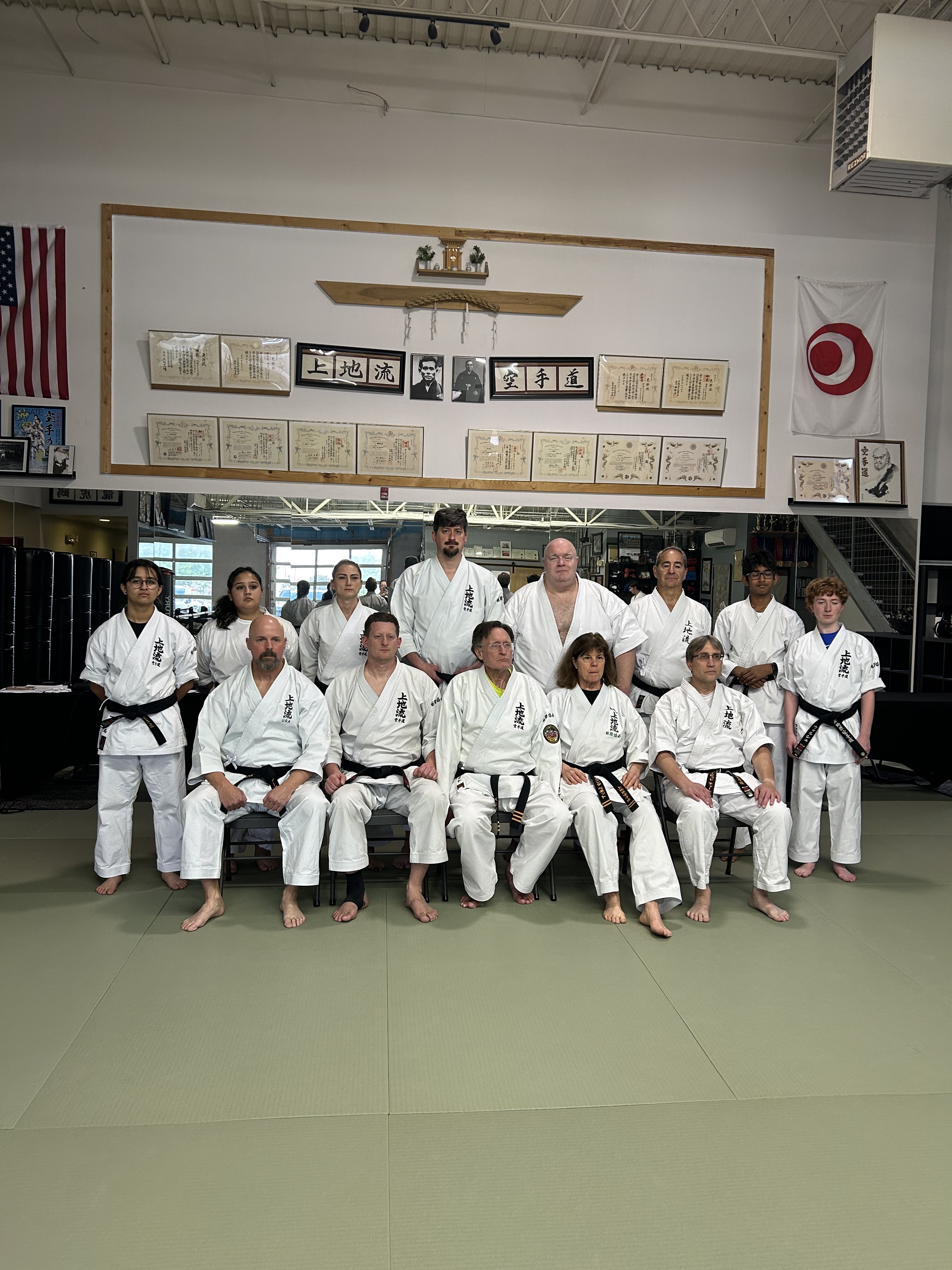
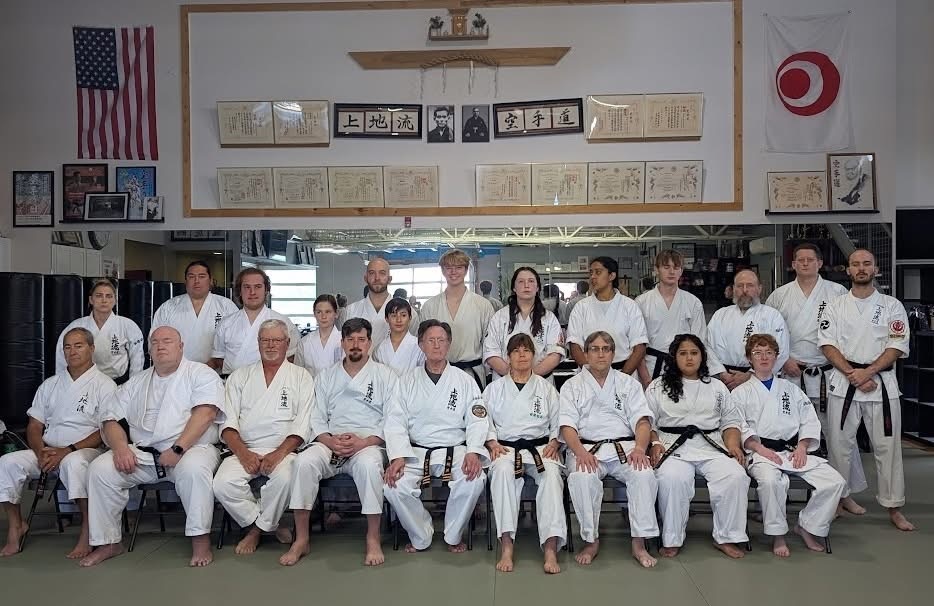
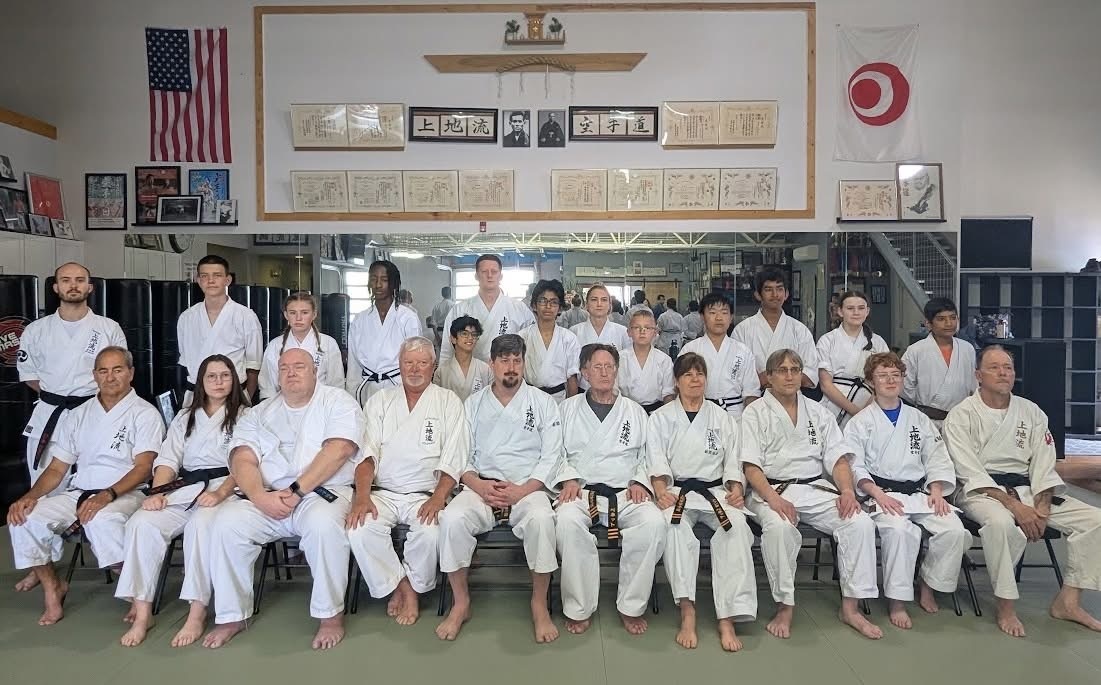
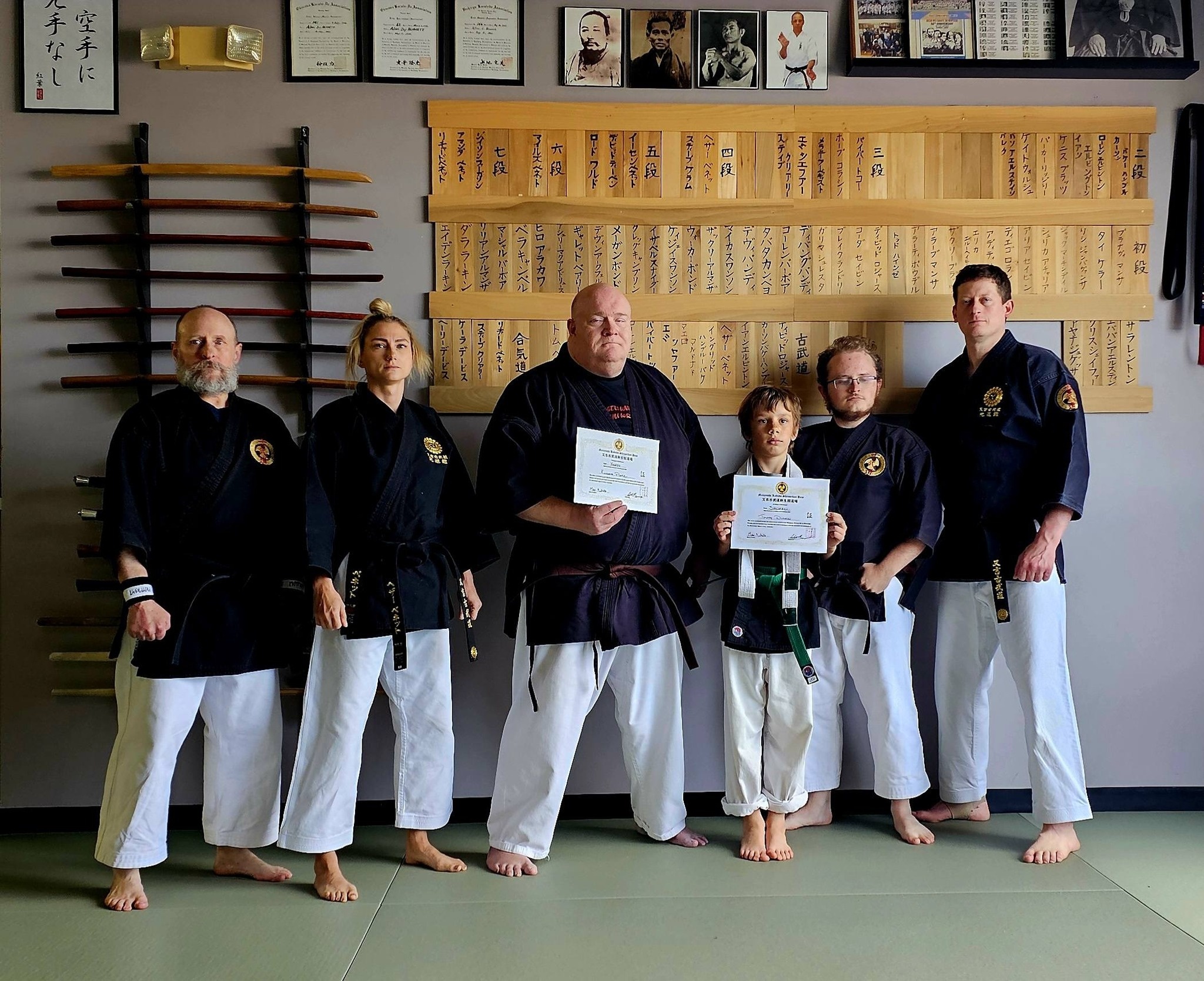
Last weekend was a VERY busy weekend at the dojo. We had our annual town fair, where our CI has a booth and runs a demonstration every year. This year he had over 40 students participating in the demonstrations for both karate and kobudo. We then had the advanced black belt test on Saturday, with 3 nidan candidates, 2 sandan candidates, one godan and one rokudan candidate. I had some nerves when I was warming up before the test, but the sanchin segment cleared them up pretty nicely. When you are performing your fundamental kata with someone beating on you, it actually helps you focus (when you've done this long enough, that is). Our CI's father (we usually just call him Hanshi) did my testing, and he made a point to leave large red fist marks on my pecs, abs, and lats. My rank kata (kanchin) went extremely well. I performed it at a speed faster than I intended to, but I was consistent throughout the kata. The other candidates said I did really well so I'm happy with that. Everything else went well, I was able to maintain my energy levels for the Seisan bunkai, right up until I bowed to the test board, bowed off the mats, and then all the energy left my body. Jason, a retired FBI agent and Hanshi's seniormost student, did my oral exam. It was very different than what I was expecting. We're generally given an information packet of questions that are likely to be on the exam, including history of Uechi-Ryu, information on key people in our lineage, vocabulary, etc. Jason asked me none of those. He started off by asking me how long I'd been training Uechi-Ryu (a bit over 8 years now), and asked me what struck me as different from Uechi-Ryu from other karate styles -- I discussed how most of the time we started our techniques with an open-handed kamae. We then discussed the origins and reasons behind that. It was a very interesting and insightful discussion. In the end we all passed. Heather (our CI's wife) had rolled her ankle earlier in the week and was performing her test with a hairline fracture in her fibula (!!!!). Fortunately since she had already earned her Shihan license, her exam was just 3 original kata (sanchin, seisan, sanseiryu) + oral exam. She absolutely nailed each segment, and then once she was out of sight of the judges, she would lay down, stretch out, and regain her composure. In any case, all 6 of us passed the first test of the weekend: 3 for nidan, Parker and me for sandan, Heather for godan, and Ethan (our CI's younger brother) for rokudan. Test #2 was Sunday morning. We had a total of 9 candidates in the morning test: 2 for shodan-sho, 4 for shodan, 2 for nidan, and 1 for sandan. All of them passed Test #3 was Sunday afternoon. Another 9 candidates: 8 for shodan-sho and 1 for shodan. All passed That's a total of 24 newly promoted black belts over the course of 2 days. With the newly minted instructors from Saturday we were able to run the tests pretty quickly, since for certain aspects of the test our CI wants a minimum of 3 evaluators for each candidate; 9 members of the board means we can have 3 pairs at a time performing bunkai, kotekitae, or yakusoku kumite at the same time. And of course... the requisite photos!
-
The Official National Hockey League Appreciation Thread
aurik replied to aurik's topic in General Chat
Living here in Avalanche Country, I had to adopt them as my second-favorite team. So I gotta say #LetsGoAvs and #GoAvsGo. In any case it will be a really good series, even if several of the top players on both sides have been taking a beating through the first 2 rounds. -
Making judo/jjj throws work
aurik replied to jay1995's topic in BJJ, Judo, Jujitsu, Aikido, and Grappling Martial Arts
Judo operates off the principle of kuzushi, or off-balancing. So if you're attempting to perform a throw on someone, they have to be unbalanced to a certain degree. If someone is leaning forward, that leaves them prime for certain hip throws or shoulder throws. If they're unbalanced to the rear, then that opens up certain other throws. One element that I've seen demonstrated with regard to aikido throws is the distraction. For example, if someone has your wrist and has it *tight*, the easiest way to get them to loosen up is to hit them. Not necessarily hard either -- a light slap to the abdomen will cause the nominal attacker to tighten up to protect the abdomen and loosen his grip on your wrist, which gives you enough freedom of movement to perform your technique without a lot of resistance from your opponent. The same principle applies to Judo throws. For example, in one of our two-person drills the attacker comes in with an overhead strike; our response is to receive/redirect the attack, drop down for an elbow strike to the solar plexus, and a backfist strike to the maxilla (right on the upper lip below the nose). We then finish the opponent off with an o-soto-gari. However, many other judo throws can be performed at this point, such as ippon seionage, harai-goshi, or even hiza garuma. The key is to unbalance the opponent, which in this case is performed by one or more strikes. -
Another round of testing at the dojo and...
aurik replied to aurik's topic in Share Your Testing, Grading, or Promotion
It's been awhile since I posted a test report, and I'll have two coming up within a week!. This past Saturday I tested for yonkyu (brown belt) in Matayoshi Kobudo. It was a test of only 2 candidates (they had also had a test the prior week) -- Tim (testing for green belt/shichikyu) and me. Since our kobudo tests are cumulative, the test started out with performing bo no hojo undo (all 3 levels, in random order), sai no hojo undo (randomly), and tonkua no hojo undo (randomly). The new material I tested on was bo no hojo undo bunkai, which consists of performing all 3 levels, both attacking and defending. Each technique has a specific attack and defense associated with it, and you're required to perform each in sequence. I demonstrated with our CI as my training partner, and he wanted me to perform the techniques in a specific way. My main concern during the test was in dialing back the power and intensity I was putting into each technique to ensure I was able to finish the test without being completely gassed. The good news is that I passed, but I received quite a bit of feedback that I'll need to address before my next test: - My (bo) gedan harai uke needs to adjust its pathing to "catch" the opponent's weapon better - When performing (sai) chudan osae uke, I need to drop my weight onto the sai more, and the sai prongs should be vertical, not horizontal. - My (bo) gedan yoko uke needs to be strong from top to bottom, not just the bottom. This also applies to the chudan nagashi uchi / gedan yoko uke / jodan nanamae uchi sequence - When performing the (tonkua) chudan tsuki / jodan harai uke / jodan yoko uchi / jodan uchi, when I raise up the (opposing) arm to allow the tonkua to go underneath, I need to visualize that as a block. So I have a lot of things to work on, but I have time to do it. I think the new element on the next test is the kata tsushi no kon. Also, this coming Saturday I'll be testing for my Uechi-Ryu sandan and shihan-dai license.
-
For a second I thought you were referring to the "gray belt" as the black belt that you've been wearing for so long it completely fades to gray/white.
-
The Official National Hockey League Appreciation Thread
aurik replied to aurik's topic in General Chat
As I was getting ready to head home from my test prep class last night, one of our students showed me that the Avs had just tied it up 3-3 with less than a minute remaining. When I got home I flipped on the game just in time to watch overtime. I was still a bit winded from the class, but definitely had enough energy for a good solid "woohoo" when the Avs won. -
We celebrate members' birthdays. If you attend class on your birthday (and let it be known), then your birthday present is that the entire class gets to do push-ups equal to your current age. Last year we had to do 40 push-ups for our CI's birthday. Fortunately this year my birthday lands on a Sunday.
-
The Official National Hockey League Appreciation Thread
aurik replied to aurik's topic in General Chat
The only games I've really been able to watch so far were a couple of the Avs/Kings games and the 2OT Stars/Wild game. Right now I'm cheering for the Avs and Stars, since my Blues did not make it into the playoffs this year (typical slow start issues that they have every single <bleeping> year). In the Avs/Kings series, both goalies have been playing amazing hockey, making the opposing team work for each and every goal scored. Definitely playoff hockey at its finest! -
I took the quiz twice -- once I answered per my current school (got a McDojo result), and an ATA school I trained at about 10 years ago (got a "not a McDojo" result).
-
Quiz: Is Your Martial Arts School a McDojo?
aurik replied to Patrick's topic in KarateForums.com Announcements
Oh noes! I'm training at a McDojo! -
We don't spar in kobudo per se, but we do perform bunkai of our hojo undo techniques. We use bamboo or rattan bo as they are much less jarring on impacts and fairly inexpensive to replace. When you perform the bunkai for the hojo undo it definitely helps with your technique; poor technique definitely shows when someone is actually whacking you with another weapon.
-
I mentioned this to Ethan later that day, and he said "Yeah, that's something you start noticing around nidan/sandan" with this "this is super cool" look on his face, which makes me feel like I'm definitely moving in the right direction
-
The Official National Hockey League Appreciation Thread
aurik replied to aurik's topic in General Chat
So, with 10 games left in the regular season (and 2 games in hand over Nashville), the Blues are sitting 4 points out of a Wild Card spot, and they are playing some of the best hockey in the NHL right now. They are 7-1-2 in their last 10, which is the best record in the Western Conference. Both of their goalies are playing really well -- they've put up a 1.5 team GAA in their last 10 games. If they can keep playing like this through the end of the season, then who knows< they might even make a decent playoff run. Stranger things have happened! (See 2019). -
Week 6 is now in the books. Our CI closed the dojo the previous week, since that's when most of the kids were on Spring Break (and he and Heather went to Tahiti for a vacation). So this past week I was fighting the fact that I'd been off for a week. Yes, I can and do train some at home, but I do not have the self-discipline to push myself as hard as others push me. I mean, that's why I train with others. Tuesday's early class was pretty rough. Heather had Parker start class with the usual junbi undo (warmup exercises), skipped hojo undo, and went straight to Sanchin. After Sanchin, we went straight to kata -- 2 each of Kanshiwa, Kanshu (then the yellow/green belts peeled off), Seichin (then the brown belts peeled off), Seisan (then the nikyus & ikkyus peeled off), Seiryu (then the 1st degrees peeled off), then Kanchin. Time for a water break and a few minutes to rest. Next we started doing kata again, but after the first repetition she'd have us face a different direction. After the second repetition, she'd face us to the front, and do mirror-image kata. And she did that for Kanshiwa, Kanshu, Seichin, Seisan. She did *not* have us do Seiryu or Kanchin mirror-image, but for Seiryu she had us all face different directions so we ran the risk of running into each other. Needless to say, by the time Kanchin came around, I was completely gassed. One thing I'm noticing that as I'm past 50, it doesn't take long for my conditioning to deteriorate, and it's harder to get it back when I start training again. So when we do close the dojo I'll need to make a point to do more training on my own or at least SOME type of cardio. Wednesday night was our black belt prep class - as this class is mainly black belts, she's more focusing on fine tuning our techniques than she is on yelling at us to do things right. (Once you've been through the prep cycle once she goes a LOT easier on you). Occasionally she'll have other instructors come up and run parts of the class so that we can get other instructor's perpective. Last night, she asked me to do the student's Sanchin checks. This was a bit of a break for me, which I appreciated. So I did all their checks, and then we went straight to the other techniques. I feel that Parker and I are starting to look really good with our bunkai and yakusoku kumite drills. I did make a point to ask Heather if to ask Richard (our CI) if we could practice the bunkai downstairs the last couple weeks before the test. Unfortunately when we are upstairs, we (or at least I) can't really do the sword attacks due to the low ceiling. I smacked the rafters once with a bokken, and I really don't want to do that again. Thursday was a combination of kobudo training and teaching. In kobudo class we focused on the first set of bo no hojo undo bunkai, and ran through that set over and over, focusing on a few of the details. The details aren't as important for me since I was the lowest rank in the group (geared more for brown and black belts), but I figure while I'm working on them let's not get into bad habits. That was also a pretty tiring session, but in a good way. Saturday we had our semiannual black belt (and black belt candidate) training. This is where our CI transfers a lot of new material that he's picked up from other senior instructors. He gave us corrections on a few of the hojo undo techniques, and then he had us run sanchin twice as a large group. He then broke us up into smaller groups, with the older students going first and the younger students second. And he did a lot of checking on Sanchin to the point we ended up staying in stance for about 7-10 minutes, which feels like a LOT longer. By the end of this, my quad was cramping and my shoulders were exhausted. But I made it through. For the second half of the day, we ran through kata, starting with Seiryu and then moving on to Kanchin (required for 2nd and 3rd degrees respectively). He broke down some of techniques, and discussed how as black belts we're supposed to start learning more of the "soft" aspects of Uechi-Ryu. One thing he mentioned is how in certain spots we're supposed to "float" or be light on our feet. And he talked about how we're supposed to start learning to flow from one movement to the next. After that, he had us start working one of the sequences in Kanchin, arguably one of the hardest ones. He broke this down into its individual components, starting with the first movement, then practicing that, then moving onto the next in the sequence, etc etc. The sequence involves doing a movement that is interpreted as catching a front kick in a shiko-dachi and then throwing the kick (and the opponent). He discussed how you need to start the throw from your back foot, and I swear, I could see the power actually transfer up his leg, through his hips, to the shoulders and the arms, like a wave moving up through him and into the imaginary opponent's leg. It's EXTREMELY hard to describe, and it'll take me a long time to figure out how to do it... but it's really cool that I was able to *see* that.
-
One Piece Live Action Series (Spoilers Through Season 2)
aurik replied to Patrick's topic in General Chat
My (13 year old) son Zach was watching the animated version and tried to get us into the live-action. I tried to watch it but just couldn't develop an appreciation for it. We unfortunately had to put the kebash on his one-piece watching because it was affecting his behaviour in ways we did not like. -
Yes, but in your first message you said: