

Furinkazan
-
Posts
40 -
Joined
-
Last visited
Everything posted by Furinkazan
-
The argument isn't for them to "transfer rank." The argument is to evaluate the new student where they are and place them accordingly. Sure, you weren't a nidan or shodan in Shobayashi-ryu. But were you really a white belt, either? Even by Shobayashi-ryu standards? Well, they did something for you. I actually happen to be in that scenario. I'm an ISKF shodan and I'm also a white belt in BJJ. I know of no one in BJJ with a black belt in karate or taekwondo who thought they were going start at anything higher than white belt. What I have seen is people with prior wrestling background get promoted to blue belt after a short time of being evaluated by the instructor. Someone else mentioned earlier in the thread that some BJJ schools will automatically place a judo black belt at blue belt. It all makes sense now, as I thought we were speaking in the context of representing schools. However, I never said anything about "transferring rank." There's a huge difference between that and evaluating new students with prior training to determine placement. I was discussing the latter. The motive for what I was saying was not to satiate egos, but to create an environment that fosters training that is both safe and productive. If you're a nidan from one branch of Shorin-ryu, and you're wearing a white belt in another branch, it's really not helping you for a brown belt to go easy on you when sparring because you're a "white belt."
-
fearing violence…
Furinkazan replied to Spartacus Maximus's topic in General Martial Arts Discussion
I don't think this means that they're inherently violent people. When I was in the Navy, we used to do fire drills alot. Main space (engine room) fire drills, where they call general quarters and everyone suits up and gets to work. In these MSFD scenarios, general quarters is called when there's a "major fuel-oil" leak - though, in real life, a major fuel oil-leak is unlikely to result in a fire at normal temperatures. Everybody hated these fire drills. We'd be in those hot one-piece firefighter suits for over an hour, complete with SCBA tank and mask, and firefighter helmet. We'd also simulate firefighting in them (a rigorous working in itself), while getting yelled at by the damage control training team. The day eventually comes where there's a real fuel-oil leak announced over the 1MC, and general quarters is called. Everyone - and I mean EVERYONE - is excited. They're moving with that sense of urgency that you'd never see during the drills. After we completely dressed out and set zebra (i.e., closing all of the hatches to contain fires), we sat and waiting until it was time to enter the main space. Eventually, the fuel oil leak was stopped. A fire never broke out. An old Chief who was nearing retirement gave us a spiel about what he saw. He himself had actually fought three main space fires throughout his career on older classes of ships where they were more likely to occur. In other words, he "knew violence" as it pertained to shipboard firefighting, and was reminding us that we didn't know the dire situation that we could have found ourselves in had a fire actually occured. No one wanted there to be a real fire. We just wanted to feel that all of the training and drills we did actually paid off. And I think that might be what's happening in the case you're talking about. I'm going to give a hot take: I think "self defense" is possibly the worst reason to train in martial arts. I think those who train for "self defense" want to "see if it works" more than they care to admit. If self defense is what you care about, then why not buy a $10 can of pepper spray and call it day? It's far more effective at neutralizing an attacker than using martial arts, and no one gets injured. It's also cheaper in terms of time and money. Those hours at the dojo could be spent at home watching Netflix. -
But why adjust for rank in competition at tournaments, and not at the school when a student with prior experience in another striking art/style signs up? Why start them at white belt when you know they can compete at the brown belt level? I don't think they not knowing your system's kata (or versions thereof) is valid. They have prior experience with kata, they know all of the stances, they know how to execute with proper kime/chinkuchi, etc. So you can feed them new katas faster than students with no prior martial arts training, ensuring that they're up to speed with a more appropriate belt ranking. Trying to make adjustments at tournaments just seems way too complicated and causes too many unresolvable problems between schools in the area.
-
Do you teach everything?
Furinkazan replied to Spartacus Maximus's topic in Instructors and School Owners
Funakoshi discussed what he learned from both Anko Itosu and Anko Asato in Karate-do: My Way of Life, and some of his other works. Both Mabuni and Gusukuma have only had the same two teachers: Itosu and Higaonna. The Shito-ryu curriculum divides their kata into two groups: the ones taught by Itosu and the ones taught by Higaonna. The Tomari-te katas are listed under the ones taught by Itosu. Hanashiro only trained directly under Anko Itosu. -
Do you teach everything?
Furinkazan replied to Spartacus Maximus's topic in Instructors and School Owners
Yes - Gichin Funakoshi, Kenwa Mabuni, Chomo Hanashiro, and Shinpan Gusukuma all learned Tomari-te kata from Itosu. I don't see why Chibana wouldn't have. -
Do you teach everything?
Furinkazan replied to Spartacus Maximus's topic in Instructors and School Owners
I'm not so sure about that. First, Chosin Chibana did create kihon and fukyugatas. In other words, he added things. Secondly, Kobayashi Shorin-ryu teaches the Naihanchi series before the Pinan series. There are valid arguments for and against this, but the Pinan series was specifically created by Itosu to be the first katas taught, which means that Chibana went against this. The other thing Kobayashi Shorin-ryu is known for is the lack of Tomari-te katas. I know of some Kobayashi-ryu schools that teach Rohai, but it was added after the fact, as neither Chibana nor Nakazato taught it. I find it hard to believe that Itosu taught all of his other students Tomari-te katas, except for Chibana. -
Do you teach everything?
Furinkazan replied to Spartacus Maximus's topic in Instructors and School Owners
I think that might be a bit controversial. I think all kata that predate karate moving to mainland Japan should be safe from elimination. All katas developed after that, especially the ones meant to be taught before the Pinan and Heian series (or Naihanchi and Tekki, if your school teaches those before Pinan and Heian) should be fair game. Even the more advanced ones, such as Ananku and Gorin should be fair game. I agree with this 100%. I think yakosoku kumite is useful, but I don't believe it should be testable. -
Do you teach everything?
Furinkazan replied to Spartacus Maximus's topic in Instructors and School Owners
There are quite a few schools out that there that have over a dozen fukyugatas and another dozen taikyoku katas on top of that (I'm exaggerating here, but you get the point) before you finally get the Pinan or Heian series. Thankfully, my school isn't one of them, but if that wasn't the case, I'd consider it "fluff" that needed to go. -
The first place I’d look is the ISKF website, since that’s the largest Shotokan organization in the Americas. Next would be JKA (both AF and WF). From there, look at WTKO, JKS, and SKIF USA. All of these websites have dojo directories.
-
There were three books that I read by Kousaku Yokota, one of which discussed this. Shotokan Myths, Shotokan Mysteries, and Shotokan Transcendence. I can’t remember which one, but it’s one of these.
-
I’m beginning to rethink this. We’re questioning this from the perspective of practicing kihon or standing in formation alternating left and right punches while the instructor counts in Japanese. Kihon and kumite weren’t always a thing in karate. They were introduced in Japan by students of Funakoshi who were also training in kendo. Prior to this, karate training was kata and hojo undo. In fact, the techniques within the kata didn’t even have names until the Japanese named them. Prior to that in Okinawa, you were simply told to “move your hands like this.” Funakoshi told his students who trained in kendo that there was no kumite or kihon in karate. Some of them didn’t believe him, so they went to Okinawa to see for themselves. He was right. So they took it upon themselves to introduce it to karate. While remembering this information about an hour ago, I stood up and did Tekki Shodan and Kanku Dai (I intentionally skipped the Heians as, for all I know, Itosu may have had specific bunkai in mind when creating them that may have been contrary to Kanku Dai and Jion), and the first two answers appear to be the most correct. What I’m saying is that the bunkai of a particliar technique is best analyzed in the context of kata, and not kihon or anything else.
-
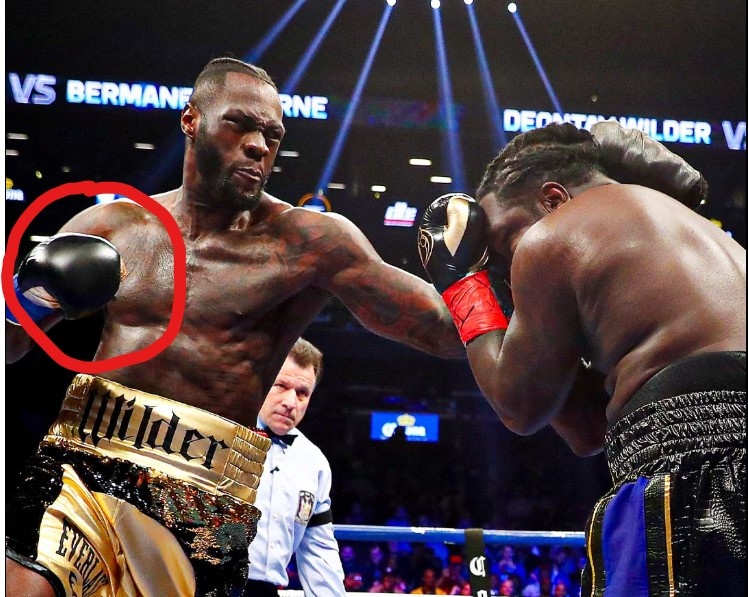
Would you consider this to be a hikite? If so, then power generation appears to be the correct answer. Wilder isn't grabbing or pulling anything. I'd also argue that, depending on where the hikite is, its use a "chamber" might be ineffective more often than not. The longer the distance your strike travels, the better your opponent's ability to keep an eye on it and block it. I'd also argue that it would be ineffective as an elbow strike because you're not looking in that direction. If we consider this a hikite, then the purpose it serves is to assist with using the hips to create a more powerful punch.

-
It looks like if I read further, you mean kata in particular. I think that would require paying for private lessons if you're trying to bypass the full curriculum. I'll play devil's advocate and say that I don't disagree with the instructor. To quote Terry Silver from Karate Kid Part III, "Did you come here to teach or to be taught?" Even in the first two Rocky movies, Mickey had to assert his position over Rocky whenever Rocky expressed disagreement with Mickey's training methods. And Rocky did the same thing with Adonis Creed in the first two Creed movies. I don't think it's unreasonable that the instructors running the school don't want someone who hasn't paid their dues hijacking their classes. When we speak of learning from lower ranks, it doesn't mean someone of lower rank assuming the role of the instructor. It usually comes in the form of the person of higher rank seeing a technique that the lower ranked student used, and specifically requesting how to execute it. If you have a technique that you want to share, I think sparring is the best time for it. That's when you'll get the feedback you're looking for.
-
My tried and true method: 1. Mix 1 part dish detergent (preferably clear, blue, green, or yellow. I worry about red "kool aid" looking stains from other colors) and 1 part peroxide. 2. Dip a toothbrush into the solution, and use the toothbrush to brush out as much of the stain as you can. 3. Put some baking soda on the wet area you just brushed, and rub it in with your finger. 4. Let it sit for an hour, clean the toothbrush. 5. Mix 1 part water and 1 part white vinegar. Also, have a separate cup of water and a cloth. 6. Dip the toothbrush into the vinegar solution and brush out the areas with the baking soda. You'll want to use the separate cup of water and a cloth to removed any baking soda from the bristles, as you don't want any baking soda to get into the vinegar solution. 7. Throw the gi into the washer. Every stain you can possibly imagine, I've removed with this method. Blood will take few washes after this to go away completely, but it still works.